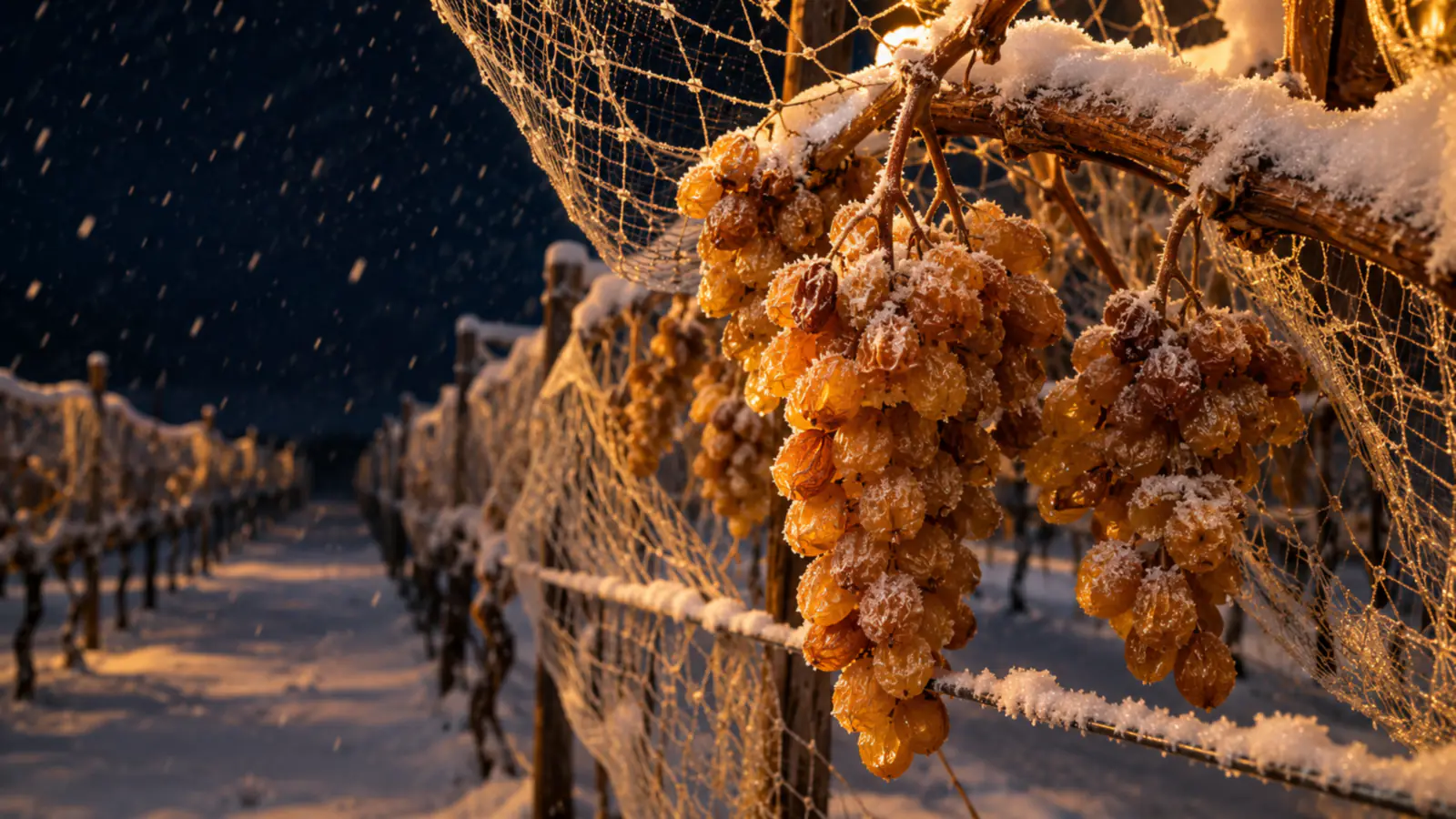
What is ice wine? It's a sweet dessert wine made from grapes that were left on the vine until they froze naturally, then picked and pressed at -8°C or colder, usually in the middle of the night. Ontario makes over 90% of Canada's ice wine, most of it in Niagara.
How much is ice wine at the LCBO? Most 375 mL bottles of Niagara Vidal ice wine run about $30 to $55. A 200 mL bottle starts around $20, and a 50 mL taster costs under $10. Riesling and red ice wines cost more, and the rarest bottles pass $100.
Below: how it's made, why it's so expensive, what's on the LCBO shelf right now, how to serve it, how long it keeps, and where to taste it in Niagara, including the January 2027 Icewine Festival.
Prices are from LCBO.com on November 18, 2026, and change often. Check your store before you go.
The short answer
It's made from frozen grapes, and that's the law. In Canada, a wine can only be called ice wine if it's made entirely from grapes that froze naturally on the vine. No freezers.
It's very sweet, but not heavy. A typical Vidal ice wine has about twice the sugar of a cola, balanced by bright acidity, at only 9.5% to 10.5% alcohol.
It's expensive because there's so little of it. Frozen grapes give about 15% of the juice that the same grapes would give for table wine.
It comes in small bottles. 375 mL is the standard. 200 mL and 50 mL bottles are common gifts.
You only need a small pour. About 1.5 oz per person, so a 375 mL bottle serves around eight.
It keeps for weeks once opened. Recork it and keep it in the fridge.
The best place to try it is Niagara in January. The 2027 Niagara Icewine Festival runs January 15 to 31.
What is ice wine?
Ice wine (spelled Icewine on Ontario labels) is a dessert wine made from grapes that stayed on the vine long after the normal fall harvest, until a hard frost froze them solid. When frozen grapes are pressed, most of the water stays behind as ice. What drips out is a small amount of thick, intensely sweet juice, and that becomes the wine.
Canada protects the name tightly:
- Federal law (section 202 of the Safe Food for Canadians Regulations) bans the words "icewine," "ice wine" or "vin de glace" on any label unless the wine is made exclusively from grapes naturally frozen on the vine, as confirmed by a provincial authority.
- In Ontario, that authority is VQA Ontario. Its rules say the grapes must be picked when the temperature is below -8°C, and the juice must measure at least 35 degrees Brix (a measure of sugar). An inspector monitors the harvest, and no wine can use the word Icewine without VQA certification.
So if a bottle says "ice wine" and it's from Canada, the grapes really did freeze outside, on the vine.
Which grapes make ice wine?
The three you'll see most in Ontario are:
- Vidal. The workhorse, and the one most people picture: golden, with peach, apricot, honey and tropical fruit. Vidal is a hybrid grape, and VQA makes a special exception to allow it in Icewine.
- Riesling. Lighter and brighter, with citrus and more noticeable acidity. Usually costs a bit more.
- Cabernet Franc. The red one. Pink to ruby in the glass, with strawberry and red berry flavours, and often the priciest.
Small amounts are also made from Gewürztraminer, Chardonnay and Cabernet Sauvignon, plus a few sparkling ice wines.
How ice wine is made
- Netting in the fall. After the regular harvest, growers wrap the rows reserved for ice wine in nets. Otherwise, birds eat the grapes over the winter.
- Waiting for the freeze. The grapes hang there, slowly dehydrating, until the temperature drops to -8°C or lower for long enough. In Niagara, that usually happens between December and February. Growers hope for a stretch between -10°C and -12°C, which gives juice of roughly 35 to 39 Brix.
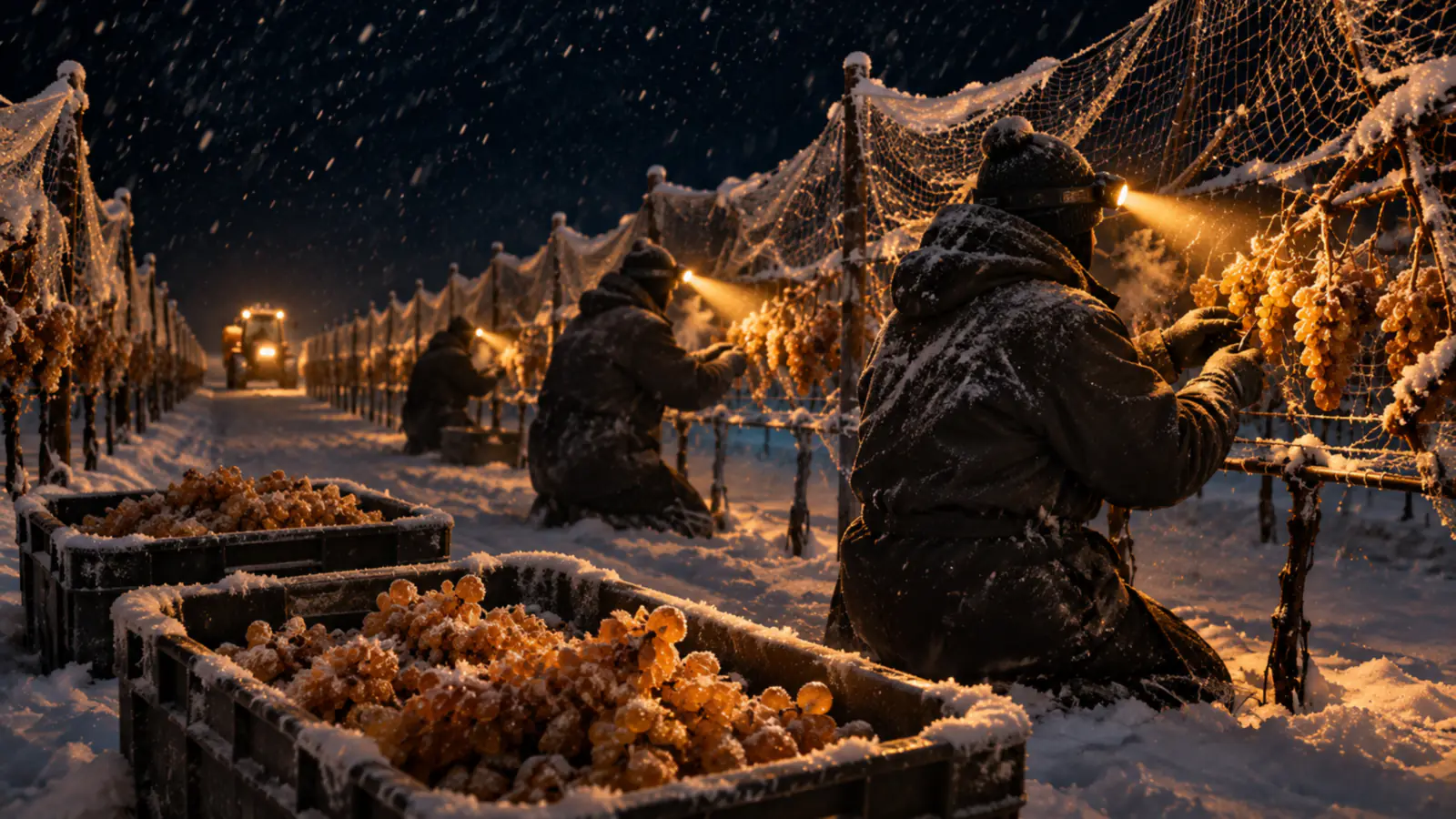
- Picking at night. Harvesting and pressing typically take at least six hours, and the coldest hours are usually overnight. Many wineries still pick by hand.
- Pressing frozen grapes. The grapes go into small hydraulic presses while still frozen. Most of what's inside stays behind as ice.
- A slow, stubborn ferment. The juice is so sweet that the yeast struggles, and fermentation stops early. That's why ice wine is both very sweet and lower in alcohol than table wine.
Ice wine vs late harvest
Ice wine sits at the top of a ladder of sweet wines that VQA Ontario defines by how ripe the grapes were at harvest:
| Style | Minimum sugar at harvest | Must freeze on the vine? |
|---|---|---|
| Late Harvest | 22 Brix | No. Often slightly sweet, can be dry |
| Select Late Harvest | 26 Brix | No |
| Special Select Late Harvest | 30 Brix | No |
| Icewine | 35 Brix | Yes, picked below -8°C |
Late harvest wines are a good way to get the style for less money. They just aren't ice wine.
Why is ice wine so expensive?
Because almost everything about it shrinks the yield or raises the cost:
- Very little juice. On average it takes about 10 frozen grapes to make 1 mL of ice wine, compared with 1.5 grapes for 1 mL of table wine. That's about 15% of the normal yield.
- Months of risk. The grapes hang on the vine for weeks or months after the normal harvest. Birds, wind, rot or a winter that never gets cold enough can cost the winery the crop.
- A brutal harvest. Crews pick in the dark at -10°C, often by hand, on whichever night the weather cooperates.
- Hard winemaking. Slow, difficult fermentations and small batches add more cost.
That's also why ice wine comes in 375 mL half bottles (and smaller). There isn't much of it, it's rich enough that a small pour is plenty, and a full 750 mL bottle would cost twice as much.
How much is ice wine at the LCBO?
LCBO.com listed more than 60 ice wines in November 2026, almost all from Ontario. Here's a cross-section, from cheapest to priciest:
| Ice wine | Size | LCBO price |
|---|---|---|
| Reif Estate Vidal Icewine VQA | 50 mL | $7.95 |
| Inniskillin Vidal Icewine VQA | 50 mL | $9.95 |
| PondView Vidal Icewine VQA | 200 mL | $19.95 |
| Reif Estate Vidal Icewine VQA | 200 mL | $24.95 |
| Peller Estates Private Reserve Vidal Icewine VQA | 200 mL | $27.95 |
| Magnotta Vidal Icewine VQA | 375 mL | $34.95 |
| Konzelmann Vidal Icewine 2025 | 375 mL | $39.95 |
| Jackson-Triggs Reserve Vidal Icewine VQA | 375 mL | $49.95 |
| Henry of Pelham Riesling Icewine VQA | 375 mL | $49.95 |
| Inniskillin Vidal Icewine VQA | 375 mL | $54.95 |
| Cave Spring Riesling Icewine VQA | 375 mL | $54.95 |
| Inniskillin Sparkling Vidal Icewine 2025 | 375 mL | $96.95 |
| Inniskillin Cabernet Franc Icewine 2025 | 375 mL | $99.95 |
| Inniskillin 50th Anniversary Zabek Riesling Icewine 2024 | 375 mL | $199.95 |
LCBO.com prices on November 18, 2026. Many are VINTAGES products, so stock varies by store.
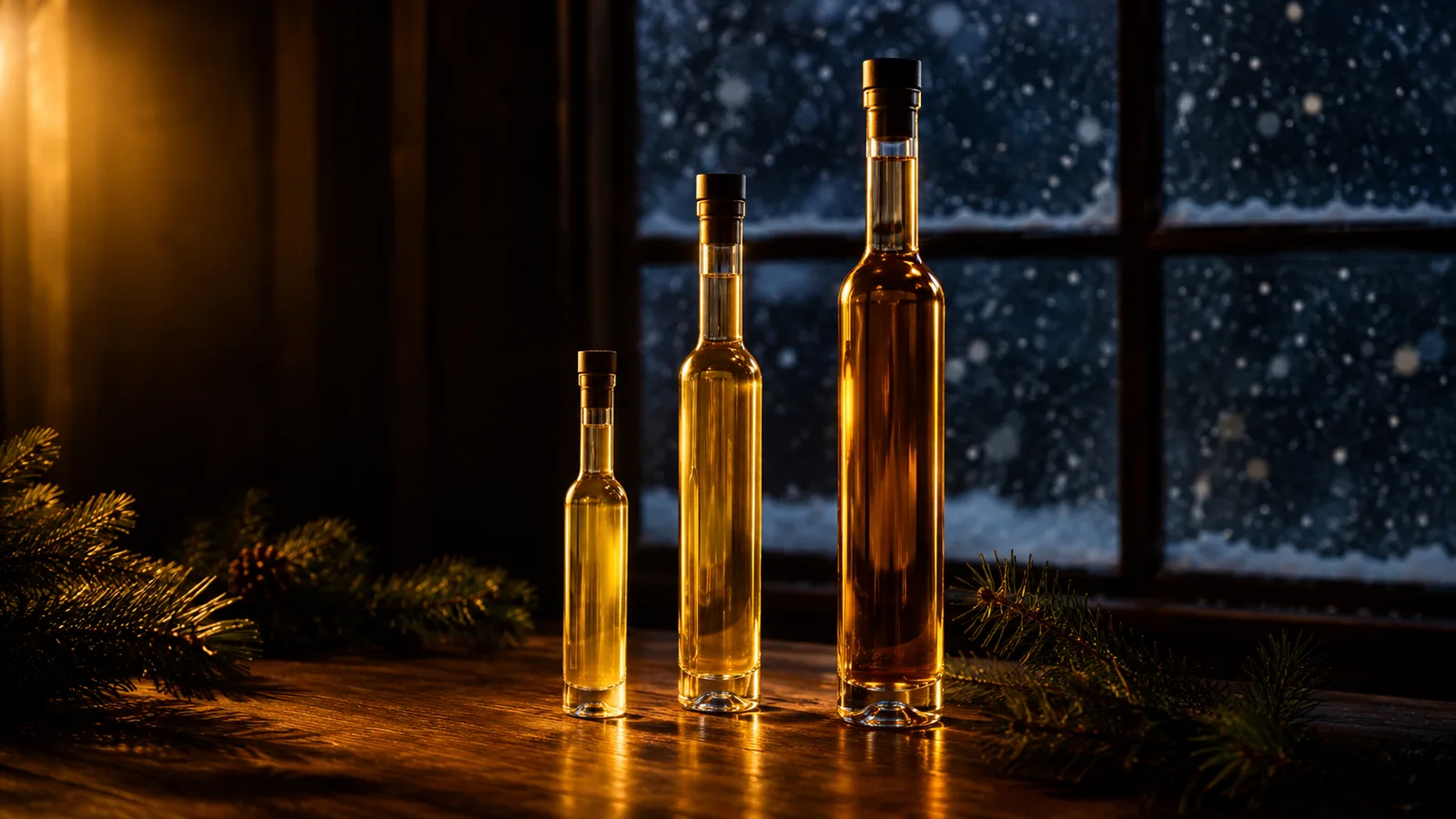
The quick rule: about $8 to $10 for a 50 mL taster, $20 to $35 for most 200 mL Vidals, and $30 to $55 for most 375 mL Vidals. Riesling, red and sparkling ice wines cost more.
Two things to watch for on the shelf:
- Look for "VQA" on the label. That's your proof the wine went through Ontario's ice wine rules.
- "Icewine & Brandy" isn't ice wine. Kittling Ridge Icewine & Brandy ($19.95, 375 mL) sits in the same LCBO section, but it's a fortified blend at 17% alcohol. It's a fine drink in its own right. It just isn't what you're paying for in a VQA ice wine. Quebec's ice cider is a different product too: it's made from frozen apples.
How to serve ice wine
- Chill it lightly. Wine Country Ontario suggests 15 minutes in an ice bucket or two hours in the fridge.
- Use a regular white wine glass. A bit of room in the glass helps you smell it.
- Pour small. About 1.5 oz (45 mL) per person. A 375 mL bottle gives about eight pours, a 200 mL bottle four or five.
- Serve it with dessert, or as dessert. It's lovely on its own after dinner.
What to pair with ice wine
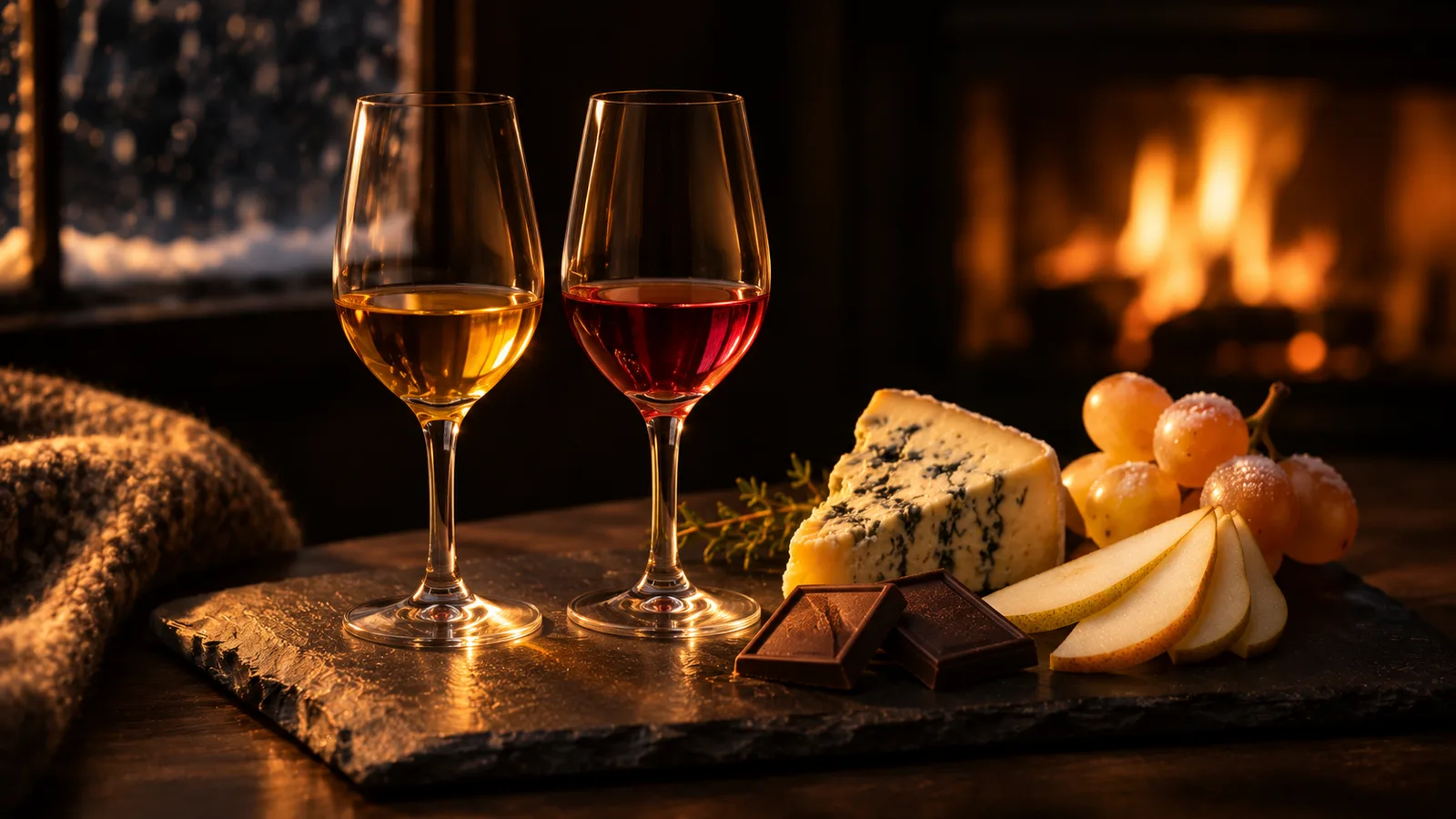
The pairing that surprises people is cheese. Ice wine's sweetness and acidity are made for salty, strong cheeses:
- Aged blue cheese (the classic)
- Foie gras or pâté
- Dark chocolate
- Fruit desserts like apple tart, peach cobbler or crème brûlée
- Spicy food, especially Thai or Indian dishes with heat
The one rule: the dessert should be less sweet than the wine. A very sugary cake can make even a great ice wine taste flat.
Two easy ice wine cocktails
- Ice wine sparkler: a splash (about half an ounce) of ice wine topped with dry sparkling wine. A good use for the last of a bottle.
- Ice wine martini: 1.5 oz vodka and 1 oz Vidal ice wine, stirred with ice and strained into a chilled glass.
How long does ice wine last?
Once opened: recork it and keep it in the fridge. The sugar helps preserve it, and Wine Country Ontario says an opened bottle keeps for several weeks that way. It will slowly lose its freshness, so taste it before you serve it to guests.
Unopened: a sealed bottle keeps for years if you store it somewhere cool and dark, away from heat and light. Vidal ice wine is generally at its most vivid in its first few years; with age it turns darker and develops more honey and caramel notes. If you're buying a gift to drink this season, you don't need to worry about it.
Where to try ice wine in Niagara
Most of Ontario's ice wine comes from the Niagara Peninsula, and you can taste it year-round at wineries in Niagara-on-the-Lake, St. Catharines and the Twenty Valley around Lincoln. Names you'll see on LCBO shelves with Niagara tasting rooms include Inniskillin, Peller Estates, Pillitteri, Reif Estate, Konzelmann, Château des Charmes, Strewn, PondView, Stratus, Henry of Pelham, Cave Spring and Tawse. Wineries often carry ice wines and vintages that the LCBO doesn't stock.
The Niagara Icewine Festival 2027
The Niagara Icewine Festival returns January 15 to 31, 2027, run by the Niagara Grape & Wine Festival. The two main parts:
- The Icewine Discovery Pass runs over three weekends: January 15 to 17, 22 to 24 and 29 to 31. You buy a pass for six or three food-and-ice wine pairings and use it at participating wineries on any day of the program. There's a discounted Flex Friday pass, and Driver's Passes with non-alcoholic pairings for whoever's driving.
- The Niagara-on-the-Lake Icewine Village turns the old town into an outdoor ice wine party on a January weekend, with tastings, local food, light displays and heated "snow globe" VIP lounges. Admission is free. The exact 2027 date wasn't posted when we wrote this, so check niagarawinefestival.com.
Plan the ride before you go. Six tasting pairings in an afternoon adds up, and January roads in wine country are dark and icy. Book a tour, use the Driver's Pass, or stay over. Our guide to Ontario's legal alcohol limit explains why "just tastings" can still put you over. If you're visiting from the U.S., remember you need to be 19 to taste in Ontario, not 21. More in our guide to the drinking age in Niagara Falls.
Is ice wine only made in Canada?
No, but Canada made it famous. Germany and Austria have made sweet wine from frozen grapes (Eiswein) for a long time, but their winters don't freeze reliably every year. Ontario's do: warm summers ripen the grapes, and winters get cold enough without being too cold. Ontario has made ice wine every year since 1984.
The turning point came in 1991, when Inniskillin's 1989 Vidal Icewine won the Grand Prix d'Honneur at Vinexpo in Bordeaux. Canadian ice wine has been a world name ever since, popular enough overseas that counterfeits became a problem. That's a big part of why Canada wrote a legal definition of ice wine into federal law in 2014.
Ice wine as a gift: timing and gift sets
Ice wine is a classic Canadian gift, and searches for it spike in the two weeks before Christmas. A few tips:
- Gift sets sell out first. In November 2026, LCBO.com listed duos like the Henry of Pelham Icewine Duo (2 × 200 mL, $59.95), the PondView Icewine Duo with a Vidal and a Cabernet Franc (2 × 200 mL, $64.95) and the Inniskillin Icewine 2 Pack (2 × 200 mL, $89.95).
- A 50 mL bottle is an easy stocking stuffer for under $10.
- Don't leave it to the last day. The LCBO closes at 6 PM on Christmas Eve and is closed on Christmas Day. Here's what time the LCBO closes on Christmas Eve, and every other date in our LCBO holiday hours guide.
Where After Dark Quick fits
Ice wine is a "buy it ahead" bottle: pick it up at the LCBO or a Niagara winery. We cover the rest of the night.
We deliver beer, wine and spirits to homes, rentals and hotels across Niagara-on-the-Lake, Niagara Falls, St. Catharines and the rest of Niagara, plus Hamilton and Burlington, from 9 AM until the legal 11 PM cutoff. That's handy when you're back from a day of tastings and nobody should be driving.
- For the ice wine sparkler: Luc Belaire Rosé or anything from our wine menu.
- For the ice wine martini: vodka, from Tito's to Grey Goose.
- For dinner before dessert: Niagara's own Peller Family Pinot Grigio.
- 19+, ID checked at the door, every order. Order by phone, no app needed, and pay at the door.
FAQ — Ice wine
What is ice wine? A sweet dessert wine made from grapes that froze naturally on the vine. The grapes are picked and pressed while frozen, at -8°C or colder, so only a small amount of concentrated, very sweet juice comes out. In Canada, the name is protected by law.
Why is ice wine so expensive? Because frozen grapes give very little juice. It takes about 10 frozen grapes to make 1 mL of ice wine, against 1.5 grapes for table wine, so yields are about 15% of normal. The grapes also hang for months at risk from birds and weather, and they're picked by hand on freezing nights.
How much is ice wine at the LCBO? About $30 to $55 for most 375 mL bottles of Vidal ice wine. 200 mL bottles start around $20, 50 mL tasters cost $7.95 to $9.95, and Riesling, red and sparkling ice wines run higher, up to $199.95 for a single-vineyard bottle (LCBO.com, November 2026).
How do you drink ice wine? Lightly chilled, in small pours. Give it 15 minutes in an ice bucket or two hours in the fridge, and pour about 1.5 oz per person into a white wine glass. Serve it on its own or with blue cheese, dark chocolate or a fruit dessert that's less sweet than the wine.
How long does ice wine last once opened? Several weeks in the fridge. Recork the bottle and keep it cold. The high sugar helps preserve it, but it slowly loses freshness, so taste it before serving.
How long does ice wine last unopened? Years, if it's stored cool and dark. Vidal ice wine is usually at its freshest in its first few years, then becomes darker and more honeyed with age.
Is ice wine sweet? Yes, very. A typical Vidal ice wine has more than 200 grams of sugar per litre, about twice as much as cola. Good ice wine still tastes fresh because of its high acidity.
What's the difference between ice wine and late harvest wine? Ice wine grapes must freeze on the vine and reach at least 35 Brix. Late harvest wines come from grapes picked late in the season but not frozen, with lower sugar minimums of 22 to 30 Brix. They're sweet, often cheaper, but not ice wine.
Is ice wine only made in Canada? No. Germany and Austria make it as Eiswein. But Canada is the best-known producer, and Ontario, which makes over 90% of Canada's ice wine, has produced it every year since 1984.
When is the Niagara Icewine Festival 2027? January 15 to 31, 2027. The Icewine Discovery Pass runs January 15 to 17, 22 to 24 and 29 to 31 at participating Niagara wineries, and the free Niagara-on-the-Lake Icewine Village takes place on a January weekend.
The bottom line
Ice wine is Niagara's signature wine: grapes frozen on the vine, picked on the coldest nights of the year, and pressed into a few drops of very sweet, very bright wine. At the LCBO, $30 to $55 gets you a good 375 mL Vidal, and it keeps for weeks once you open it.
Buy it before the holiday rush, taste it at the source in January, and pour it small. And if you're in Niagara and the night needs more than dessert, we deliver beer, wine and spirits until 11 PM. Call 416-627-7846.